
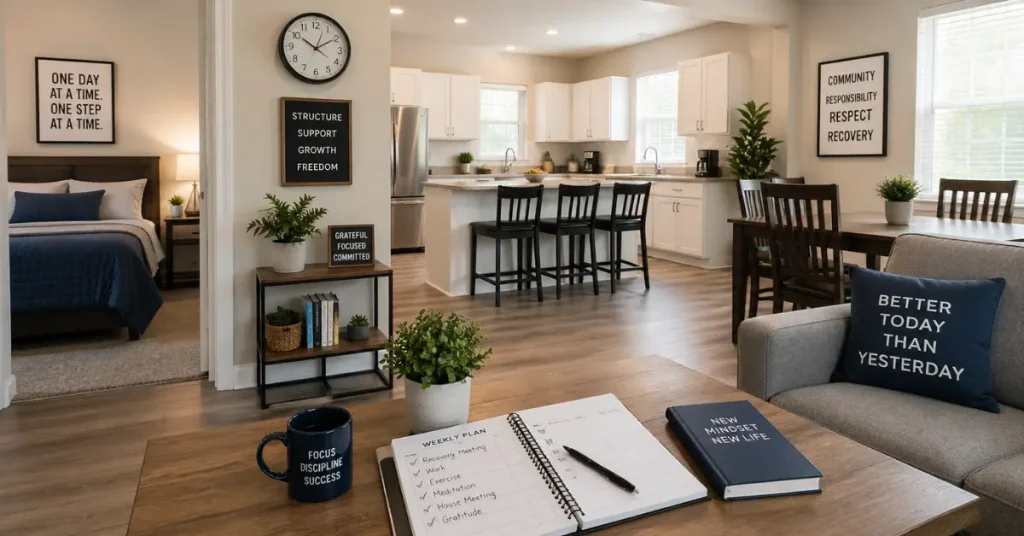
Not everyone needs the same level of structure in recovery.
Some environments don’t provide enough accountability. Others may feel it is too restrictive.
Structured sober living offers a balance, combining independence with consistent expectations and accountability.
Deciding to make a change is one step. Figuring out what kind of environment can actually support that change is often the harder part.
Too little structure can make progress difficult to maintain. Too much structure can feel unnecessary for some people.
That is why many men find themselves somewhere in between, trying to understand whether a more structured setting would genuinely help or whether they can manage with less support.
For families, the question can feel just as important. The challenge is often not whether recovery matters. It is understanding what kind of environment gives it the best chance to hold.
Why Does Environment Matter More Than Motivation?

Motivation can help someone begin. Environment often determines whether progress continues.
Many people believe recovery is mostly about determination, but daily surroundings often shape behaviour more than intention alone.
Your environment can influence:
- The routines you follow each day
- How easy consistency feels
- The habits that become normal
- The choices that feel automatic
- Whether accountability stays visible
Even strong motivation can slowly fade when the environment keeps reinforcing the same patterns that caused problems before.
That is why some people begin asking, ‘Is sober living right for me?’ because they start seeing that the issue may not only be commitment. It may also be the environment they are trying to recover inside.
What Are Signs You May Need More Structure?
Not everyone needs the same level of support. Some men can rebuild stability with minimal outside structure. Others find that independence keeps leading back to the same cycle.
More structure may be worth considering if:
- Staying consistent has been difficult
- Routines often fall apart after a few weeks
- Progress feels temporary
- The current environment feels unpredictable
- Accountability is missing
- Motivation feels strong but never lasts
- Too much unstructured time creates setbacks
These signs do not automatically mean someone needs a major change. They can simply indicate that more support may help create consistency that has been difficult to maintain alone.
In many cases, this becomes clearer when you begin to see how accountability in sober living keeps you consistent in day-to-day life.
When Does Living at Home Stop Supporting Progress?

Living at home can work in the right situation. For some men, home offers stability and support. For others, it can quietly make progress harder because the same environment remains unchanged.
Living at home may become difficult when:
- Old triggers still exist nearby
- Routines are not supported
- Accountability feels inconsistent
- Family stress affects progress
- Boundaries are unclear
- Familiar patterns keep repeating
This is often where people begin comparing sober living vs living at home. The issue is not always the person. Sometimes the environment itself is making consistency harder to hold onto.
Structured Sober Living vs Independent Living
Both options can be appropriate depending on the person. The difference often comes down to what someone needs right now rather than what sounds better in theory.
| Independent Living | Structured Sober Living |
|---|---|
| Full freedom over daily life | Clearer expectations |
| Complete personal responsibility | More consistent routines |
| Fewer outside expectations | Accountability that stays visible |
| More privacy | Support from the environment |
| Less built-in support | A gradual path toward independence |
The difference is rarely an effort alone. It is often the level of support that surrounds that effort.
To better understand how structure actually works in practice, it can help to explore what structured sober living for men actually looks like.
When Might Structured Sober Living Be the Right Fit?

Structured sober living is not the right answer for everyone.
For some men, however, it can provide the balance between independence and support that has been missing.
It may be the right fit when:
- Consistency matters more than freedom right now
- Current routines are unstable
- Accountability improves follow-through
- Independence has not been working
- Daily life feels too unstructured
- A transition from treatment needs support
- Previous progress has been hard to maintain
This is often the point where the right path becomes clearer. The goal isn’t permanent dependence, but creating enough support now so independence can actually work later.
For many men, the difference becomes clearer when they can picture what a typical day in structured sober living looks like.
How Can Parents Know What Their Son Needs?
For parents, the decision can feel overwhelming. Many parents are not only looking for help. They are trying to understand what level of support may actually make a difference.
Questions parents often ask:
- Can he realistically manage on his own?
- Does he need more structure than he has now?
- Is home helping or creating setbacks?
- Would accountability improve consistency?
- What environment gives him the best chance to stabilise?
In many situations, the difference is not motivation. It is whether the environment supports follow-through when life becomes difficult. That is often what families are trying to understand before making a decision.
What Questions Should You Ask Yourself Before Deciding?

Sometimes clarity starts with the right questions. Instead of trying to predict everything, it can help to look honestly at the current situation.
Questions worth asking:
- Is consistency the main challenge right now?
- Does the current environment support routine?
- Are old habits still too easy to return to?
- Would more structure feel supportive or excessive?
- Is independence creating stability or more stress?
- Have previous attempts been difficult to maintain?
These questions can make one ask, ‘Do I need sober living?’ easier to answer with more clarity. Sometimes the answer becomes clearer when you stop focusing only on the person and start looking at the environment around them.
Why Does the Right Level of Support Feel Unclear at First?
Some men know immediately that they need more structure. Others feel unsure because they are somewhere between wanting independence and needing support. That uncertainty is common.
Structured sober living is not always about needing intense oversight. Sometimes it is simply about needing an environment that makes consistency easier.
The right fit often depends on:
- How stable life feels today
- How often routines break down
- How much accountability helps
- Whether independence has been sustainable
- What kind of support feels realistic
That is why structured sober living vs independence is often less about one being better and more about which one fits the current stage of recovery.
How to Find Clarity Without Rushing the Decision?
You do not need every answer today. You only need enough clarity to understand whether your current environment is helping or making progress harder than it needs to be.
For many men, the next step becomes easier once they can clearly picture what daily life in a more structured environment could actually feel like.
You can also explore what a typical day in structured sober living looks like.
Talk Through What Might Work Best
If you are unsure what level of structure may help, talking through your situation can make the next step feel clearer.
Sometimes one honest conversation can help you understand what kind of environment may provide the consistency that has been missing.
Confidential. No pressure. Just a conversation to help you move forward.